Up, Up, and Away: The 747 Takes Flight

The magic of post-World War II America was that what had been previously inaccessible to the masses was now within reach, even commonplace. Owning a home with shiny new appliances, an automobile (sometimes more than one), getting a college education. Even flying the friendly skies.
The onset of the Jet Age in the 1950s brought with it a sharp rise in air travel. Whether it be exotic locales, sunny vacation destinations, or family trips to visit relatives too far away to reach by car, the airplane quickly became the new way to travel. And everybody was doing it. By February 1969, almost half of all Americans had flown in a plane.
There were a lot of factors at play in the growing appeal of flying. The stunning growth of the economy after World War II created a middle class with disposable income, putting air fares within reach of more consumers and chipping away at the so-called exclusivity of air travel. Companies began granting blocks of time for employees to take vacations, giving families entire weeks in which to get into adventures in far flung destinations. Airlines were also in a pitched battle to woo customers, and they pulled out all the stops to make the sale.
In the 1960s, airfares were still regulated by the government, so there were no fare wars. But there were perk wars. Fresh cooked meals (yes, you used to be able to get a real meal on a plane), in-flight movies, comfortable accommodations, you name it. Even the flight attendants were dolled up. In those days, they were all attractive, young females and sometimes dressed in uniforms that made them look more like go-go dancers than stewardesses. Was it sexist? Hell, yeah. But airlines at the time were catering to their largest demographic, male business travelers, and the concept of corporate good citizenship was still many years away.
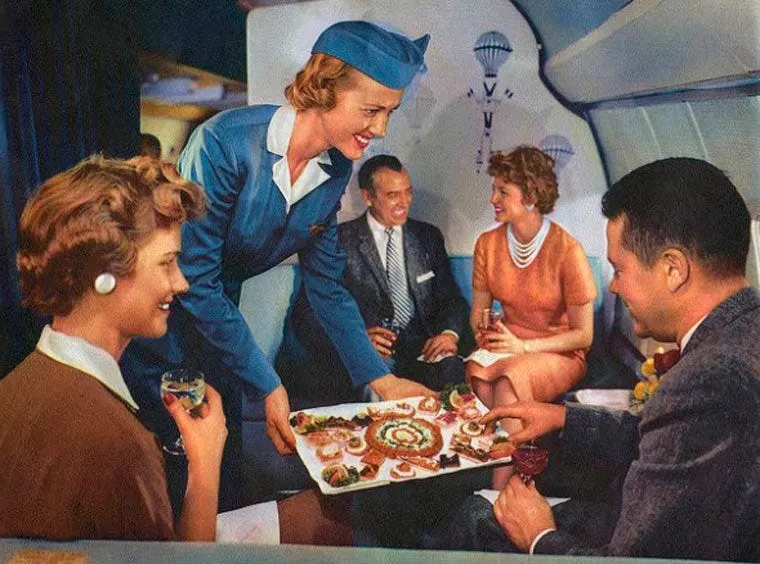
The Golden Age: No service animals. Everyone kept their shoes on. And planes were on time. Image: AirlineRatings.com.
The other way that airlines could draw passengers was through technology. Planes that were faster, better designed, and more spacious would be the ones that would draw customers. The airlines were also looking for planes that were more cost effective to operate. That meant better fuel economy and being able to cram more passengers onto each flight.
With this goal in mind, Juan Trippe, aviation pioneer and head of Pan American World Airways, approached the Boeing Company about building a larger than average passenger plane. Trippe wanted something that was twice the size of Boeing’s 707, which could seat anywhere from 150–180 passengers depending on the design variant. Pan Am was the first airline to fly the 707, and it was the plane that was widely credited with ushering in the Jet Age. Boeing was already noodling ideas for wide-body planes for military and commercial cargo use, but Trippe’s interest in applying the wide-body concept to passenger air travel inspired the aviation company to put drafting pencil to paper.
This was a true meeting of giants. In the 1960s, Pan Am was the world’s premier airline, carrying some seven million passengers annually on a fleet of 150 jets to 86 countries on an 81,000-mile route network. If you wanted greater reach than that, then you had to look to the U.S. Air Force.
Boeing was no slouch, either. The aviation company was behind some of the world’s best-selling commercial aircraft, like the aforementioned 707. Boeing was also an integral part of American defense and the space program. It was behind the fear-inducing B-52 Stratofortress, and it was one of the manufacturers of the massive Saturn V rocket that would catapult American astronauts to the moon.
Pan Am placed an order for 25 747s in April 1966, putting down $525 million (that’s $3.7 billion in today’s greenbacks) for the effort.
Boeing staked its reputation on the 747. It was a major endeavor that required an entirely new assembly plant in Everett, Washington. The design and building of the new wide-body airplane was on such a tight schedule that construction began before the factory roof was even finished. When it was finally completed, the 747 assembly plant was equal in area to 40 football fields. It was the largest factory of any kind in the world, and the largest building by volume ever built.
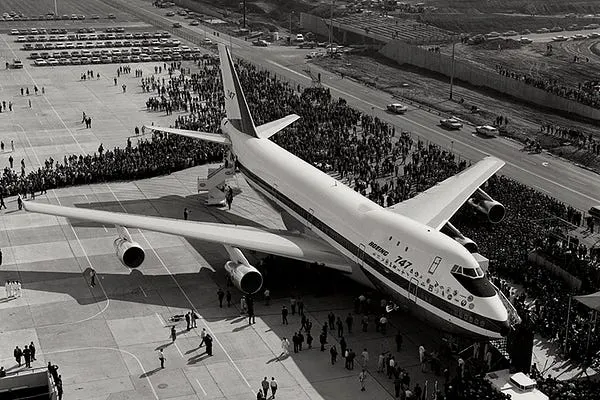
Any introduction of the 747 was bound to be big.
The first 747 rolled off the assembly line on September 30, 1968. Press, aviation enthusiasts, and executives from the 26 airlines that had placed orders gathered from all over the world to ogle Boeing’s latest creation.
As far as passenger planes went, the 747 was a monster. It was 231 feet (70.4m) long with a wingspan of 195 feet (59.4m). The tail was 63 feet (19.2m) high. It could seat between 360 and 400 passengers depending on the seating configuration. The first 747 model had a range of 4,600 nautical miles and a speed just shy of Mach 1.
The 747 took its first test flight on February 9, 1969 and handled quite well, but further test flights revealed some hiccups with the engines and a wing oscillation issue that needed to be addressed. Boeing spent much of the rest of 1969 fixing these problems and fine tuning the plane. It ran into cost overruns that nearly sank the company, but by December 2 the 747 was ready to make its first passenger flight, carrying 191 people from Seattle to New York City.
On January 15, 1970, First Lady Pat Nixon christened Pan Am’s first 747 at Dulles International Airport, inaugurating the age of wide-body air travel.
The 747 was a marvel of aviation and American engineering. It would dominate the large plane market until the larger Airbus A380 went into service in 2007. Boeing has produced over 1,500 747s over the last five decades, encompassing several passenger and cargo variants.
The end of the line for the 747 may be approaching, though. Most of the wide-body jets that have been produced over the last several years have been scooped up for the cargo market by large international haulers like FedEx, UPS, and such. Demand for new 747s by passenger airlines has dropped steadily as newer, smaller planes by Boeing and other manufacturers can fly farther and faster on less fuel.
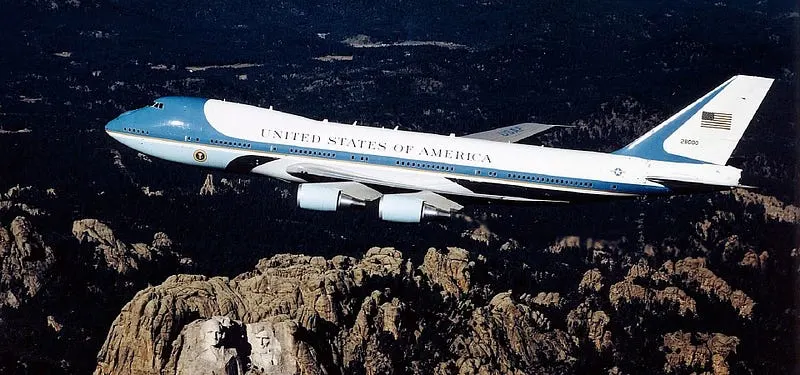
The world’s most famous 747. Two updated models will be ready in 2024.
Airbus will soon be dropping out of the wide-body market altogether. The company announced on February 14, 2019, just a few days after the 50th anniversary of the 747’s first flight, that it was discontinuing the A380. Airbus was never able to carve a large enough chunk out of the market to sustain a profit, and no other aviation company has plans to try to compete with Boeing.
Whatever the future holds for wide-body jets, it can truly be said that the Boeing 747 dominated the market from start to finish.