Reagan and Gorbachev’s First Brush with Peace

It’s been called the beginning of the end of the Cold War. But in 1986, the Reykjavik Summit was treated more like the beginning of the end of the world.
U.S. President Ronald Reagan and Soviet leader Mikhail Gorbachev met in the Icelandic city by the sea in early October 1986 as sort of a pre-summit summit. They had met for the first time in Geneva, Switzerland the year before, and that event showed promise for thawing relations between the superpowers.
Geneva had been the first meeting between superpower leaders in six years. It also thrust Gorbachev onto the world stage. The youngest member of the Soviet Politburo had only recently become General Secretary, and he brought with him new ideas and a fresh perspective on how the Soviet Union should conduct itself at home and abroad. Reagan, who was eager to engage the Soviets and slow down the arms race, was excited at the opportunity to finally get down to business with someone who shared his goals.
The biggest outcome at Geneva was probably that Reagan and Gorbachev had established a solid working rapport. They agreed to two more summits in Washington and Moscow in the next couple of years and became earnest pen pals.
Gorbachev wrote to Reagan about the possibility of phasing out nuclear weapons in three stages by 2000. Reagan wrote back with a counterproposal to make huge reductions in offensive missiles, eliminate intermediate-range nukes, and share strategic defense technology. Gorbachev gushed, “We simply must meet! We can’t wait until the Washington Summit.”*
The Reykjavik meeting was set up with just a couple weeks’ notice, and negotiators on both sides were cautiously optimistic and rightfully wary.
Not since Nixon and Brezhnev clinked champagne glasses in Moscow in 1972 had there been a greater promise of improved relations between the superpowers. But a lot had happened since then. There were a lot more missiles ready to fly. There was a lot more Soviet hanky-panky in third world nations. There was greater tension between East and West. In the first ten months of 1986 alone, there had been the American bombing of Libya, the reactor meltdown at Chernobyl, and a brief spy war known as the Daniloff-Zakharov Affair.
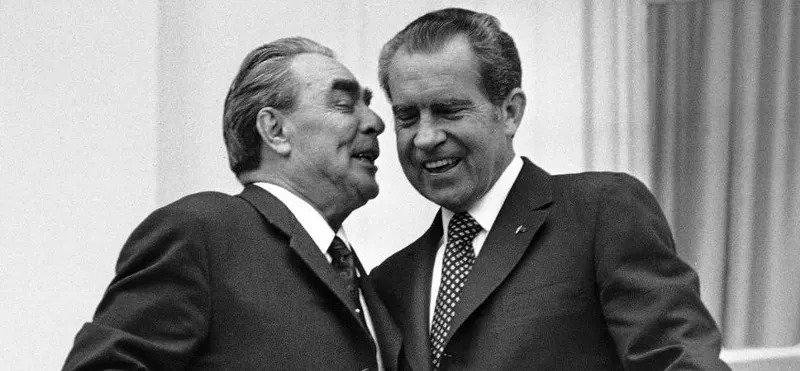
Nixon & Brezhnev were superpower BFFs and SALT I was the outcome. Image: AP.
Gorbachev was under tremendous political pressure back in Mother Russia. His reform plan for perestroika (restructuring at home) and glasnost (openness abroad) would need the support of the Soviet leadership and the byzantine communist bureaucracy if it were to succeed. The price of that support was an assurance that Gorbachev could shore up national security. Securing an arms agreement with the Americans could help achieve this. And part of that agreement would be getting Reagan to let go of his precious Strategic Defense Initiative (SDI).
Reagan was not in the same pickle. He was in his last term, and his popularity with the American public remained strong despite the best intentions of his political opponents. But there was history to answer to, as well as his long-standing personal goal to rid the world of the scourge of nuclear weapons.
Reagan had an opportunity to use Gorbachev’s eagerness to meet to America’s advantage. While Gorbachev came to Reykjavik to single-mindedly talk arms control, Reagan had a broader objective in mind. He wanted to link arms control to the Soviets’ long-standing record of human rights abuses. For Reagan, human rights was linked to international peace because any nation that disrespected human rights and repeatedly demonstrated a lack of respect for international treaties and conventions on the issue could not be trusted.
But Gorbachev was no fool, either. He knew that SDI was a controversial program in the U.S. and abroad. Opponents of the space-based anti-ballistic missile system argued that it would destabilize the delicate nuclear balance. They also ridiculed it as enormously expensive and unworkable, giving it the nickname “Star Wars” to indicate that it was just as realistic as the science fiction fantasy film.
Of course, this begs the question, if SDI was so impossible to create, then why worry about it being destabilizing? Well, because sooner or later it could have been built. The Soviets were more confident about America’s technological prowess than Reagan’s political opponents in the Democratic Party and the media. The Soviets also knew that such a system would effectively end the arms race in an American victory because they did not have the resources to match it.
Gorbachev believed that if he linked Soviet opposition to SDI to any arms agreement, he would have the advantage. The Soviets would either get an arms agreement that ended SDI, or short of that, show the world that Reagan’s stubbornness over SDI was the only obstacle to an agreement.
And so, the drama played out in Reykjavik.
Gorbachev said, “Let’s get rid of strategic missiles.”*
Reagan responded, “Let’s get rid of all ballistic missiles.”
Not to be outdone, Gorbachev said, “Let’s limit the number of nuclear weapons.”
Reagan raised the ante. “Let’s get rid of all the nuclear weapons.”
Gorbachev leaned forward. “Then drop SDI.”
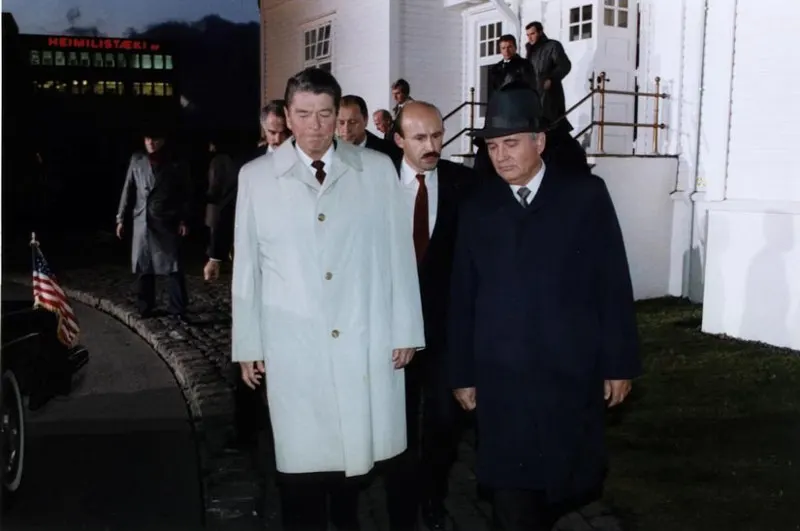
So close to a deal, neither man could hide his disappointment from the cameras. Image: Ronald Reagan Presidential Library.
The needle scratched across the record. The flames in the fireplace flickered out. If somebody had dropped a pin, it would have hit the floor like a hammer.
Reagan refused to give up SDI. It was part of his national security strategy against the USSR, which many Americans still considered to be an enemy. He offered to share the technology, but Gorbachev scoffed that America wouldn’t even share milking machine technology. Of course, if the Soviets needed assistance with their milking machines, then the socialist system was a bigger failure than Reagan said it was.
The Reykjavik Summit ended with famous photos of Reagan and Gorbachev glumly returning to their cars and heading in separate directions. In western media, Reykjavik was largely labeled a failure, and Reagan’s stubbornness over SDI was to blame. Gorbachev’s plan worked. Sort of.
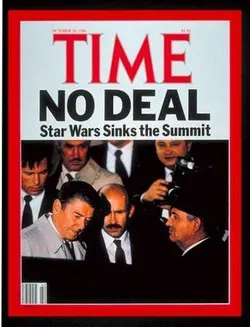
When all else fails, blame Star Wars. Image: Time, Inc.
Dan Rather went on the CBS News calling Gorbachev’s proposed cutbacks as “absolutely unprecedented” and that the “whole package came apart when President Reagan refused to scale back his ‘Star Wars’ program.”
This was typical of Reagan’s detractors in the press. The New York Times and Rolling Stone, among many other media outlets, lay the blame for failure at Reagan’s feet. This was an easy sell because since his election in 1980, Reagan had been portrayed by his opponents in the press as a warmonger. He was the godfather of an unprecedented arms buildup that included terrifying new conventional and nuclear weapons.
In all fairness, this accusation needs to be put into perspective. Many of the military programs that Reagan supported and funded had been signed off and developed years before he became president. If you want to blame anyone for willing the MX missile and other dreadful weapons systems into existence, you should look at Richard Nixon, Gerald Ford, and (gasp) Jimmy Carter. That’s right, America’s 39th president, who liberals viewed as a paragon of peace and conservatives viewed as a squish, ordered America to upgrade some of the deadliest toys in its arsenal.
Reagan definitely spent more on defense than all those guys put together. That can’t be denied. The ultimate goal of this was, however, to make the Soviets think twice about continued territorial expansion, and to give America the opportunity to negotiate from a position of strength when the time came. Calling Reagan a warmonger rings hollow when you consider that, during the early 1980s, the Soviets were engaged in multiple battles of conquest in Afghanistan, Angola, and Central America.
The Reykjavik-as-failure narrative didn’t hold for long, though. Behind the scenes, U.S. and Soviet negotiators made progress on a number of human rights issues, including the release of high-profile dissident Anatoly Sharansky. This in turn led to a continued warming of U.S.-Soviet relations and more engagement on social and cultural levels. And the arms control negotiations continued all the while, leading to an historic agreement the following year.
The Intermediate-Range Nuclear Forces (INF) Treaty of 1987 (less easily remembered as the Treaty Between the United States of America and the Union of Soviet Socialist Republics on the Elimination of Their Intermediate-Range and Shorter-Range Missiles) was an unprecedented breakthrough in U.S.-Soviet relations. It ended an entire class of weapons — nuclear and conventional ballistic and cruise missiles with ranges of 500 to 5,500 kilometers. By 1991, over 2,500 missiles were dismantled, and all the offensive nuclear weapons in Europe that gave NATO and the Warsaw Pact flop sweats for decades were removed.
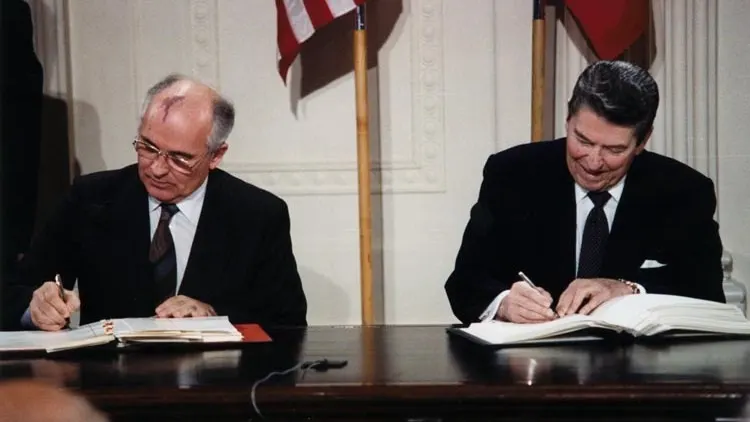
Funny how some things work out. Gorbachev and Reagan sign the INF treaty. Image: Ronald Reagan Presidential Library.
People who were in the rooms with Reagan and Gorbachev and those who hammered out the final details of the treaty confidently say that the INF could not have happened without Reykjavik. That Icelandic meeting, though few saw it at the time, was a stepping stone toward better relations between America and the Soviet Union, and ultimately the dissolution of the USSR just five years later.
*These are not direct quotes, only my interpretation of what was said.
Don’t forget to sign up for regular updates from Mr. Rick’s History Magazine. You’ll get cool and entertaining facts sent to your inbox every month! Have something in your email to look forward to for a change.