Nixon Pitches Back Channels and Secret Talks

Just weeks into his term in 1969, Richard Nixon was already laying the groundwork for big plans that would define his presidency and reshape the nature of world politics. He had spent the last several years writing, traveling, and meeting with dignitaries far and wide, and he was eager to put that work to use.
Nixon had his legacy on his mind, but the American public was more concerned about Vietnam. They wanted Nixon to fulfill his promise to end the war. But it wasn’t so simple as ordering our boys in Southeast Asia to pack up and come home. The United States made a commitment to protect South Vietnam, and we had a larger role in protecting the free world from the spread of communism.
The most ardent anti-war protestors had lost their patience long ago. They had zero interest in things like American prestige and international commitments. A potent subgroup among them actually welcomed the idea of a diminished United States. But Nixon knew, as did Lyndon Johnson before him, that simply walking away from Vietnam would send a message to our friends that we were a fair-weather ally that couldn’t be counted on when the chips were down. And the communists would figure that we didn’t have the stamina for the long game. Sure, the Vietnam War would be over, but Moscow would simply press its advantage elsewhere in Asia, Africa, maybe even Latin America.
Nixon saw only one way for America to get out of Vietnam and maintain some semblance of international clout, and that was for South Vietnam to be capable of complete self-defense. If the South could hold its own against North Vietnam, then America could say job well done and move on to other adventures. As things stood in February 1969, though, the South didn’t stand a chance against the North Vietnamese Army and the Vietcong without American help.
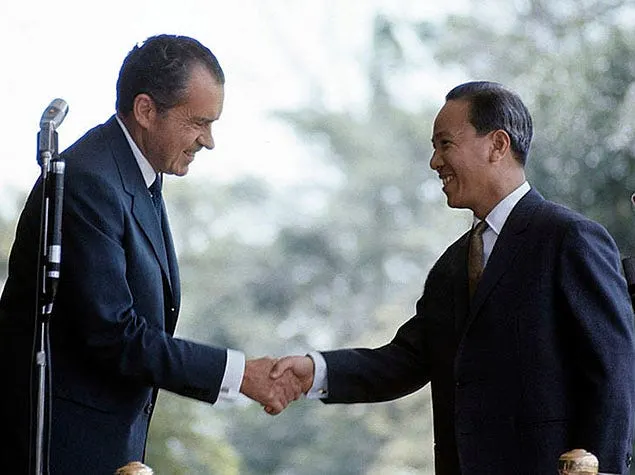
Nixon wanted to give South Vietnamese President Nguyen Van Thieu the tools he needed to defend his country. Image: Paul Slade/Paris Match via Getty Images.
What Nixon needed was time to build up South Vietnam and wear down the North, all while demonstrating to the American public that he was winding down our military commitment in Southeast Asia. It was a complicated problem, and complicated problems call for complicated solutions. Well, maybe that’s not true, but that is what Nixon had in mind.
Nixon formulated a plan to reach out separately to both the Soviet Union and Communist China in an effort to improve relations with both countries. Not only was it a chance to ease global tensions, but it was a chance to split the Sino-Soviet alliance and get North Vietnam’s communist big brothers to put pressure on that country to seek a settlement of the war.
Welcome to triangular diplomacy — the use of relations with one country as leverage to extract concessions from another. This was international relations on steroids. It was a gamble that had never been tried, but there was a chance that it just might work.
The Soviet Union and China may have both been communist countries in the eyes of the West, but in 1969, each nation saw the other as a cheap knockoff of traditional Marxism. Both Beijing (known at the time as Peking) and Moscow believed they were the rightful heirs to the worldwide communist revolution, and relations between the two countries had rapidly deteriorated.
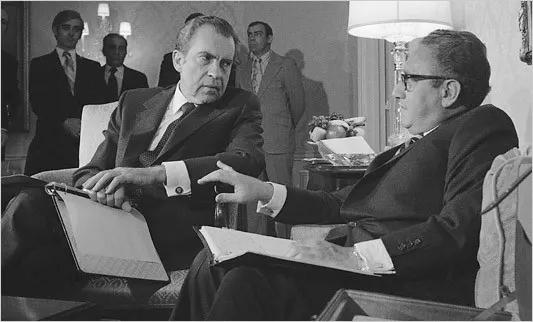
Nixon and Kissinger worked so closely that they earned the nickname “Nixinger.” Image: Richard Nixon Foundation.
Nixon saw an opening. On February 1, 1969, he ordered National Security Adviser Henry Kissinger to open a secret dialogue with the Chinese government. Talks would be held in Poland, a nation where both the U.S. and China had embassies. The topic of conversation would be examining American diplomatic recognition of Communist China, which we had refused to do since 1949.
Meanwhile, Nixon’s team was also involved in conversations with Soviet Ambassador to the United States Anatoly Dobrynin. Dobrynin was a respected member of the Kremlin hierarchy, having served as ambassador since early 1962 (He would continue in that post until May 1986, serving during the terms of six U.S. presidents). Nixon wasted no time in meeting with Dobrynin, hosting him at the White House on February 17, 1969.
The two men agreed to open a “back channel” between Dobrynin and Kissinger to discuss major issues of interest to both countries, including dialing back the nuclear arms race. It was a chance, as Nixon noted in his inaugural address, to move from a “period of confrontation” to an “era of negotiation.”
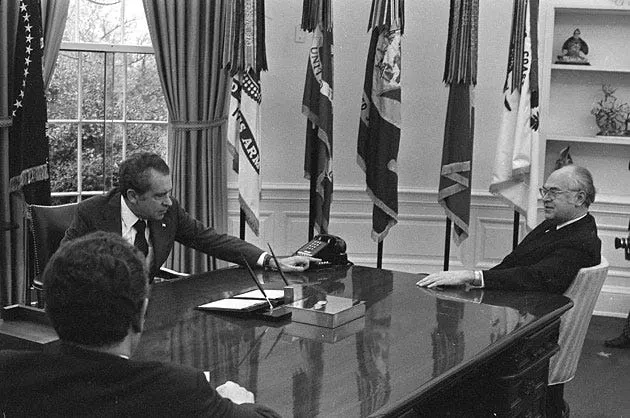
Nixon and Dobrynin in the Oval Office. Kissinger, back to camera, looks on. Image: Central Intelligence Agency.
The public had no clue that these back channels had been opened, and that is how Nixon wanted it. If he was going to triangulate between the Soviets and the Chinese, then neither nation could know he was talking to the other. Otherwise, the opportunity for leverage would disappear.
There were advantages to back channel diplomacy. If the participants could count on mutual confidentiality, then there would be a willingness to take bigger, bolder steps toward an agreement. They could more clearly communicate their interests and explore areas of potential cooperation without having to worry about upsetting international allies. And if things didn’t work out, both sides could walk away without losing face.
Back channel diplomacy suited Nixon’s management style. He preferred to run foreign policy personally from inside the White House. And there was also Nixon’s trademark distrust of…well, pretty much everybody. He didn’t trust career diplomats to properly handle the complex plan he was laying forth. He didn’t trust the State Department because of the potential for press leaks. He didn’t trust the press because of the mercurial relations he held with reporters much of his political life. And he didn’t trust the Washington bureaucracy in general because it was prone to inertia and reflexively protecting the status quo.
There was always the danger that back channel diplomacy and secret dialogues could lead to an insular foreign policy regime that squeezed out legitimate players like Secretary of State William Rogers. People whose job it was to help manage America’s international relations might have contributions to make to the effort, but Nixon and Kissinger believed that they had all the angles covered.
There was nothing terribly unusual in pursuing back channel dialogues with other nations. Nixon didn’t invent the concept, and his wasn’t the first presidential administration that used back channels as a negotiating tactic. Besides, he wasn’t about to let himself get hung up over a few secrets kept inside the White House. Richard Nixon had an appointment with destiny, and he had no intention of being late.