From Campus Protest to Armed Insurrection

In April 1969, the nation watched with a mix of fear and rage as two respected Ivy League universities were seized by student mobs. At Harvard, a university so old it predated America itself, students stormed the administration building and forcibly ejected the dean to protest the ROTC presence on campus. At Cornell, black students with loaded firearms broke up an otherwise peaceful parents’ weekend to protest the university’s perceived racist system.
This was not the first time students had taken over a campus by force. The nation was still reeling from the Columbia University student takeover that had taken place just twelve months earlier, and a lot had happened to make the country a much more violent place since then. The assassinations of Martin Luther King and Robert Kennedy, hundreds of riots in cities across the country, and the televised melee at the Democratic National Convention in Chicago were all seen as evidence of a nation coming undone.
Now it appeared that the student movement to protect democracy, end the Vietnam War, and promote civil rights had kicked democracy to the curb and embraced violence as a means of achieving their goals. Sure, it was a totally counterintuitive approach, but the increasingly radical leaders of the movement didn’t care. They were not interested in making the system work. They were interested in burning it down.
America’s institutions of higher learning had become another battlefront in a nation at war with itself.
In the years following World War II, the higher education system came to occupy a unique place in American society. Once a bastion of the privileged, college became more accessible to the masses. A conglomeration of programs like the GI Bill, the National Defense Student Loans, and others originating in government and the private sector broke down the financial barriers that prevented all but the wealthy from attending college.
As America entered the 1960s, colleges began undergoing major changes, even if only in fits and starts. Minorities and women were joining the ranks in greater numbers, and colleges were going co-ed. Then the first of the baby boomers started hitting America’s campuses. That’s when things got complicated.
The American college students of the mid-1960s were the sons and daughters of the World War II generation. They grew up in a country that was wealthy and powerful, and they were surrounded with comforts that their parents knew only as luxuries. This informed young Americans with a different worldview than previous generations, one in which they were more acutely aware of the injustices and hypocrisies that existed in society.
With the birth of the Free Speech Movement at the University of California, Berkeley, in 1964, college students demonstrated their political and social awareness. Students for a Democratic Society (SDS), an influential nationwide network of college students dedicated to leftist political ideals, created a united front to protest the Vietnam War, racism, imperialism, and economic inequality.
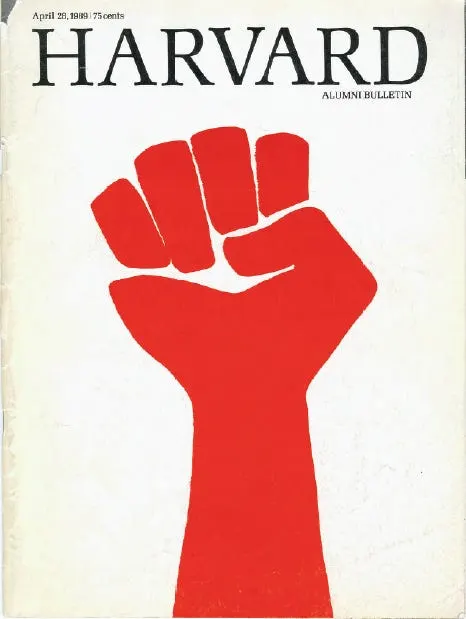
With young, agile, energetic, and terribly impatient souls driving this movement, college campuses became hotbeds of political action. While they were at first eager to engage in what SDS referred to as participatory democracy, by 1969 many within the movement had grown dissatisfied with the slow pace of change. Perhaps they did not reckon that democracy tends to be slow and messy, a history class lesson that might have been missed while they were marching in the streets.
Direct action replaced participatory democracy as the strategy of choice. When the Columbia University administration gave in to SDS and Afro-American Society demands in April 1968, it sent a signal to college students nationwide that campus takeovers might be the way to go.
At Harvard University earlier in 1969, students and sympathetic faculty protested the University’s plans to expand into working class neighborhoods and tear down buildings to make way for a new medical center. There was also a growing call to abolish the campus ROTC, which was believed to be promoting the imperialist war machine on campus.
This was a sentiment that was shared on college campuses across the country. The Reserve Officer Training Corps was designed to offer military training to college students across the country. For decades it was considered part and parcel of the college experience. In the 1960s, however, ROTC was increasingly tied by protestors to the Vietnam War, and it was frequently the target of campus demonstrations.
Harvard students grew annoyed that their calls for change had not been met, so on April 9, 1969, 30 of them entered University Hall and forcibly ejected the administrators and staff. One dean was picked up bodily and taken outside after he refused to leave. Another 300 students flocked to the building to join the takeover. Doors were chained shut, the red and black SDS flag was raised, and the siege began.
University President Nathan Pusey refused to negotiate and called upon the metropolitan police to clean things up. In the wee hours of April 10, 400 police officers waded into the building swinging billy clubs and spraying mace with abandon.
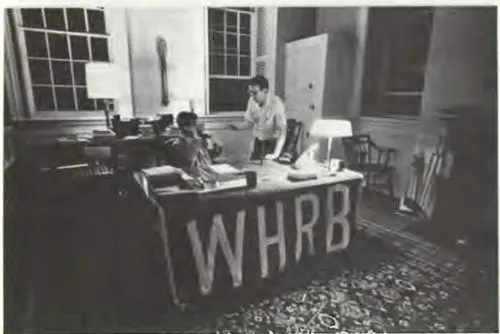
Two students were sentenced to nine months in jail for assault and battery, 23 were expelled with the option to reapply later, and three were expelled permanently. A student strike followed that shut down the campus for a week, but the administration soon gave in, promising a reexamination of Harvard’s ROTC and community engagement policies.
While Harvard was dealing with its own internal strife, tensions at Cornell University in Ithaca, New York were likewise bubbling over. Since 1963, Cornell had been undergoing changes to increase minority student enrollment and become more accommodating to students of color. University President James Perkins and the administration faced accusations of lowering academic standards for minorities in order to meet self-imposed admissions goals and of recruiting inner city black militants to give the student body a more “urban” appeal. This led to a backlash from some whites and a backlash to the backlash from some black students.
On April 10, while Harvard students were being rounded up and sent off to jail, Cornell approved a $240,000 investment to create an Afro-American Studies Center. The Afro-American Society (AAS) intended for this center to be completely autonomous and separate from the rest of Cornell. Some faculty, staff, and students protested this move because it would divide the campus along racial lines, which apparently was precisely what AAS wanted.
Tensions rose on campus. At the start of Parents’ Weekend later that month, a burning cross was discovered outside a dormitory for black women. The next day, April 19, about 100 black students, led by AAS, stormed into Willard Straight Hall declaring their intention to hold the building until their grievances were recognized and addressed.
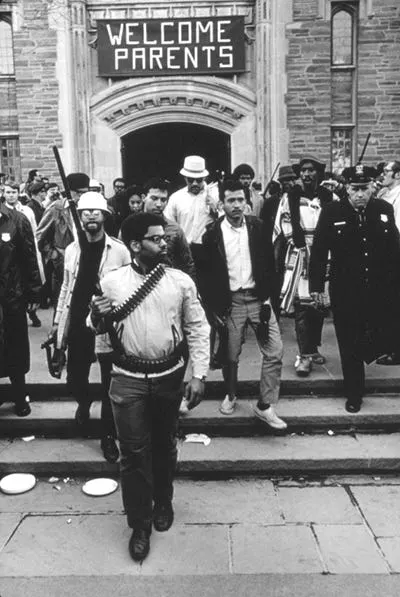
Later that morning, white students from a campus fraternity attempted to take the building back by cracking some heads, but they only inflamed tensions. Black students armed themselves with shotguns and rifles, and SDS volunteers formed a cordon around the building to keep people away. Cops came in from Rochester, Syracuse, and other surrounding towns, some no doubt with visions of knocking students around like at Harvard just a few days prior.
This time, though, the students were armed, and the potential for bloodshed was real. Police suggested that the cross-burning was actually performed by AAS to gin up an excuse to storm Straight Hall. AAS member Thomas Jones didn’t do his effort any favors when he said, “Before this is over James Perkins, Allan Sindler, and Clinton Rossiter [both political science professors] are going to die in the gutter like dogs.”
By the end of the weekend, though, cooler heads prevailed. Sort of. The faculty bought AAS’s threats and, fearing wider campus unrest, gave in to student demands. Anyone associated with the building takeover was given complete amnesty, all previous campus disciplinary actions against AAS members were rescinded, and Perkins, who originally championed a greater black presence on campus, was forced to resign.
As predicted in the media and elsewhere, the Harvard and Cornell campus incidents inspired student uprisings at Dartmouth, Princeton, Tulane, and other universities. Students took over buildings, physically intimidated staff and fellow students who disagreed with them politically (not everyone on college campuses supported the movement to unmake society), vandalized property, and in some cases destroyed years of faculty research.
The actions of these militant students, if the word ‘student’ could even be applied to such folks at this point, were in the pursuit of social justice, in itself an admirable reason. Unfortunately, the manner in which they pursued it only further alienated them from many otherwise sympathetic Americans who saw them as spoiled, violent kids. The only outcome that could be guaranteed was that the fight would continue, and that it would get uglier.