Sock It to Me! Nixon is Inaugurated

It’s January 20, 1969, and Richard Nixon is taking the oath of office as the 37th President of the United States. For Nixon, it is the culmination of a life spent in public service. For those who voted for him, it is hope for a return to law and order, a chance for America to get its act together and start feeling proud again.
For the anti-war movement, the counterculture, and the Old and New Left, it seems like a complete rejection of everything they have been fighting for throughout the decade. The Sixties were supposed to be about change, shaking off the old order, smashing the Establishment. Yet, the one man who most closely symbolizes everything these people reject is now president.
How could things turn out this way? Was this a dreadful miscalculation of the country’s political sensibilities? Did Nixon have America under an evil spell, or did he find a way to tap into the nation’s darkest impulses?
It was nothing nearly so dastardly or mystical. It was just one of those moments that often happens in the American story when politics and history collide. Those at the time who paid close attention to what was going on were not nearly as surprised at what was taking place on the east portico of the U.S. Capitol in Washington, D.C. that cloudy day in January 1969.
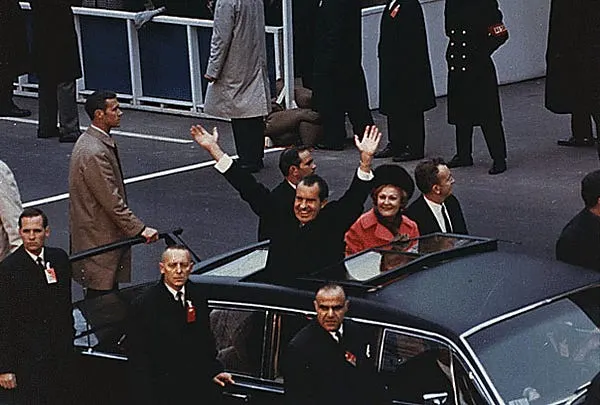
The inaugural parade that eluded Nixon eight years ago. Image: CBS News.
Popular history surrounding Richard Nixon’s rise to the presidency has placed so much emphasis on the dissolution and chaos of the Democratic Party in 1968, that we are almost led to believe that Nixon just snuck up on the country and took over while all the adults weren’t looking. To believe this to be the case gives too little credit to Nixon’s political savvy, too much credit to Democrat leaders at the time, and almost no credit at all to the American public.
Nixon, despite his rather self-indulgent announcement that he was quitting politics in ’62, always had one eye on getting back in the arena after he lost to John Kennedy in ’60. He had come too close and he was too much a political animal to just retire to private life. And he also still had a lot of support in the electorate. Straw polls frequently placed him at or near the top of lists of potential presidential candidates in ’68.
Things began turning in Nixon’s favor back in 1964 when incumbent Democrat Lyndon Johnson beat Republican Senator Barry Goldwater in one of the biggest landslides in American history. LBJ’s historic mandate, shaped in part by the assassination of his predecessor, led optimistic Democrats to believe that we were witnessing a political realignment that happens only once in a generation. They were partially right. There was a political realignment coming, but not the one they were expecting.
Johnson spent every ounce of political capital he had on the Great Society, an ambitious progressive program that stuck a government finger in every domestic pie — education, healthcare, employment, welfare, criminal justice reform, civil rights, workers’ rights, elder rights, minority rights. Like the New Deal before it, the Great Society would harness the power of the federal government to shape a better America, just as the liberals always intended.
Yet, America’s liberals couldn’t marry themselves to Johnson. They admired his domestic policies, but they grew frustrated with his pursuit of an increasingly illusive military victory over the communists in Southeast Asia. A progressive policy in America couldn’t be reconciled with what they viewed as an imperialist policy in Vietnam. And when the Great Society began to suffer for lack of funds that were being used to support the country’s expanding military commitment in Vietnam, Johnson’s support began to crumble.
Democrats lost 47 seats in the House and three in the Senate in the 1966 midterm elections, but they held their congressional majorities, so this did not seem like that big a deal. Nixon, who was on the road stumping for Republican candidates in ’66, saw it differently. Many of the seats Democrats lost were those that made up the decades-old New Deal coalition. Republicans had cracked the Democrats’ solid south for the first time since Reconstruction, and Nixon believed this could be the seeds of that generational political realignment that everyone was making such a big deal about two years before.
Nixon wasn’t the only Republican who saw opportunity in the 1968 race. Several candidates emerged to compete for the GOP nomination, most notably California Governor Ronald Reagan. Representing the conservative wing of the party, Reagan actually scarfed up more primary votes than Nixon in ’68. But Nixon’s support of candidates in ’66 and his work behind the scenes in securing the backing of GOP kingmakers earned him more delegates at convention time. And delegates are what make nominees.
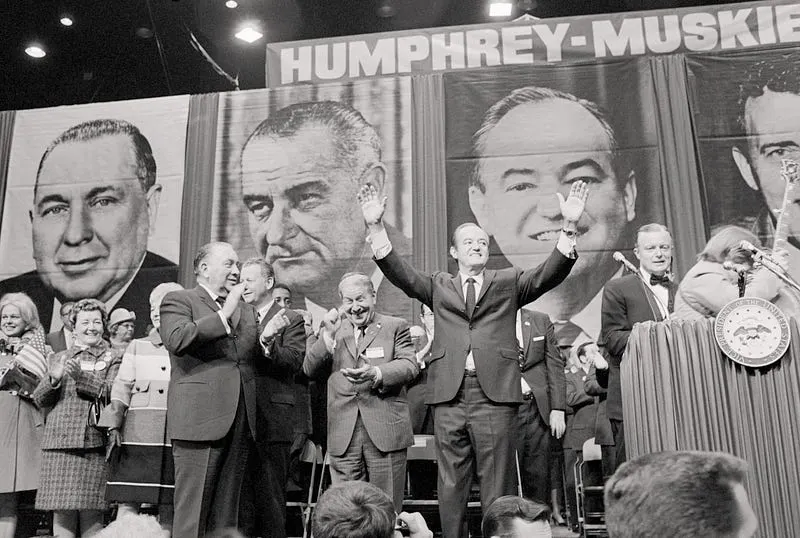
Try as he might, Hubert Humphrey couldn’t get out from under Lyndon Johnson’s shadow. Image: AP.
On the Democrat side, the road to 1968 was fraught with peril. Everyone initially expected Johnson to run for reelection in ’68. Then he was challenged within his own party for the nomination and withdrew. Then emergent anti-war candidate Robert Kennedy was assassinated. Then the Democratic National Convention in Chicago turned into a chaotic and violent circus shrouded in a cloud of tear gas.
Vice President Hubert Humphrey rose from the ashes with the Democratic nomination for president, but he was in a tough spot over Vietnam. Liberals wanted a candidate who was unequivocally against continuing the war. Up until now, Vice President Humphrey had dutifully supported the Johnson line on Vietnam. To come out against the war now would refute many of the statements he had made these last four years. It would also run afoul of Johnson’s efforts to secure a peace settlement before leaving office, however vain those efforts might be.
Humphrey also had to contend with the third-party candidacy of Alabama governor George Wallace. An old-school Southern Democrat who supported segregation (today, he would simply be called a racist), Wallace knew he couldn’t win a conventional race. His candidacy was designed to deny the two major party candidates a majority of electoral votes, throwing the election into the House of Representatives and presumably giving Wallace a hand in shaping federal policy going forward.
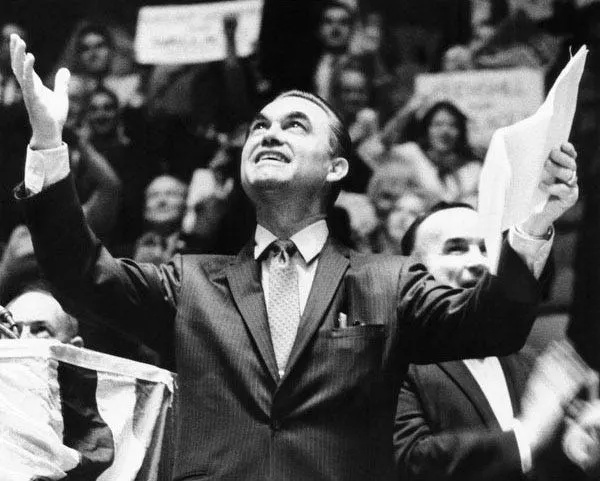
George Wallace was no fringe candidate. He drew 17,000 people to Madison Square Garden in New York City in October ’68. Image: AP.
Wallace’s campaign drew Democrats who were disgruntled about civil rights, voters who might otherwise have supported Humphrey. Nixon pursued these voters as well, applying what he termed a “Southern Strategy” to further chisel away at the southern states of the old Confederacy that had been a Democratic stronghold for generations. It initially seemed as if Wallace’s campaign would siphon support away from Humphrey, since they were both Democrats. Wallace’s campaign had a negative effect on Nixon as well, though. Every Democrat who defected to Wallace was one less vote Nixon could count on, which became a problem for the Republican in the campaign’s closing stretch.
Humphrey surged in late October, closing the gap with Nixon. He came out against the war and called on Johnson to halt the bombing of North Vietnam. Wallace’s campaign was also coming apart, which worked in Humphrey’s favor. A verbal gaffe by Wallace’s running mate, retired Air Force Gen. Curtis LeMay, was used by the opposition to claim that Wallace would end the Vietnam War with a nuclear attack. When Johnson announced a possible peace deal with North Vietnam the weekend before the election, the presidential race between Nixon and Humphrey turned into a dead heat.
Humphrey’s surge came just a bit too late to do him any good. Nixon won the 1968 presidential election by a little over 500,000 votes against his two opponents. Had it not been for Wallace, who presented the strongest third party candidacy of the modern era, Nixon probably would have won by a larger margin, successfully peeling away disgruntled Democrats in the South.
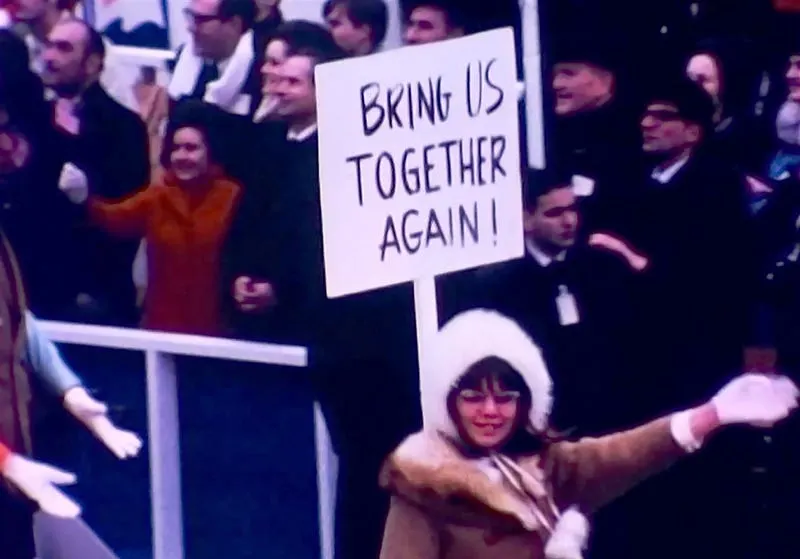
We’ll see.
It wasn’t just politics alone that gave Nixon the White House, though. Americans in 1968 had grown tired of the chaos. Frankly, they had also grown tired of the Sixties. What had started out as a decade of positive, cultural change had morphed into a period of violence and division unrivaled since the Civil War. Whether Richard Nixon was truly the man to bring the country back together remained to be seen. But citizens were fairly certain it wasn’t going to happen under the Democrats. They had been in charge of the country for eight years, and look where things were at.
It was time for a change. Call it a return to law and order, a rejection of liberal government, the end of the Age of Aquarius, whatever you like. In the final analysis, the inauguration of Richard Nixon in January 1969 represented a reckoning and a realignment.
Republicans would solidify their hold over the South in the years after ’68. They would win six of the next nine presidential elections, three by historic margins, and force Bill Clinton, the only two-term Democrat of the last half of the 20th century, to adhere closer to the center on domestic policies.
Throughout 2019, Mr. Rick will be looking back at 1969, the year the turbulent 60s came to an end. Subscribe now and be sure to catch new features on that year’s entertainment, lifestyle, politics, and much more.