Zeppelin Ascends, Beatles Fade, the King Returns

It’s January 1969, and three musical powerhouses are hard at work, all at very different stages in their careers.
You could look around and see that there’s never been a more exciting time for popular music. The last several years completely redefined rock and roll. Acid rock, psychedelia, folk, blues, pop; it was all in flux. The 60s were all about change, in every respect. And rock and roll, which provided the soundtrack for the decade, was changing in magnificent ways.
The rock and roll of the 1950s, which some parents saw as the earliest sign of the decline and fall of Western civilization, was stale by comparison. Sure, Buddy Holly, Pat Boone, and Bill Haley and His Comets were all great. But rock was not about catchy tunes anymore. Even Elvis Presley, the King of Rock and Roll, was having a hard time adapting.
Presley was still around in 1969, but King of Rock and Roll? That’s probably just an honorific title by the late 60s, like how you still refer to a former governor or president by their title even after they’re out of office. Elvis was a movie star. All but one of the albums he recorded between 1962 and ’68 were soundtrack albums to his increasingly bland, empty films. Some might of thought Elvis was all done. This new era of rock music was not for him. Was Elvis all washed up?
Not likely. The one album of original, non-film material he recorded during that time earned him his first Grammy for Best Sacred [Gospel] Performance for How Great Thou Art. Many remember the King of Rock and Roll as…well, a rock and roll guy. But Elvis was considered one of the finest male gospel singers of the time, no kidding.
Elvis proved on December 3, 1968 that he was still the King. That night, the NBC special, Elvis, aired to a huge audience and would become NBC’s highest rated show of the season. The subsequent album remained a big seller through the holidays and well into the new year.
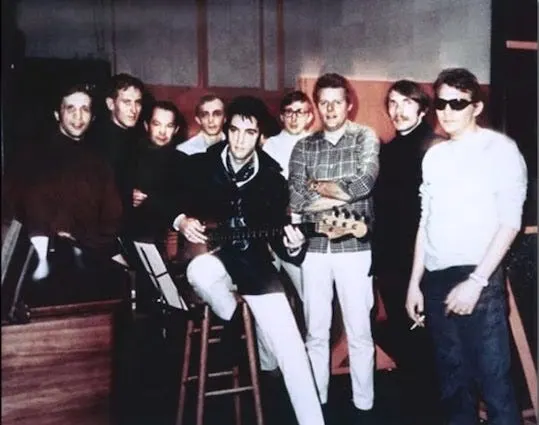
Elvis and company at the American Sound Studio in Memphis. Image: RCA Records.
On January 13, 1969, Elvis went back into the studio. The wind was at his back, and he had some good material ready to record. During the second half of January, Elvis would record tracks for From Elvis in Memphis, which would be released on June 17. Among the tunes recorded were “In the Ghetto,” which would reach number three on the Billboard Top 10, his first top 10 hit in four years. “Suspicious Minds” would reach number one, and though nobody would know this for years, it would be Elvis’s last number one Billboard single during his lifetime.
But that bit of foreshadowing aside, in January 1969 Elvis Presley was getting back in the game. He steered clear of protest rock and kept his political opinions to himself. That’s fine, though, because Elvis was a rocker, he was always a rocker, and that’s what people loved about him.
Elvis was a huge influence on all the great bands that came after. The Beatles, who came of age in Liverpool, England, grew up on Elvis. John Lennon once said, “If there hadn’t been Elvis, there would not have been the Beatles.”
The Beatles eclipsed Elvis, but there were no hard feelings because they eclipsed everybody. They reached all the limits that pop had in store, then pivoted and went into uncharted territory. Revolver, released in 1966 before their final tour, began an era of musical experimentation and discovery for the Beatles. Then, of course, came Sgt. Pepper’s Lonely Hearts Club Band and Magical Mystery Tour in 1967, The White Album in ’68, and Yellow Submarine, a new album/film soundtrack which was released on January 13, 1969. The film, which had been released the previous summer, was a fan favorite in both England and the States.
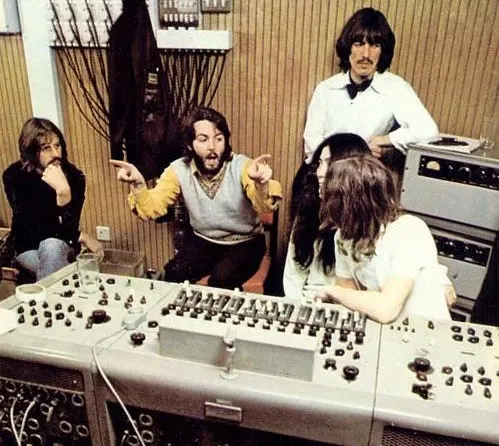
Ringo, Paul, George, and John (and the ever-present Yoko) at Twickenham. Image: Apple Records.
The Fab Four were back in the studio in January, having hunkered down at Twickenham Film Studios right after New Years to begin work on Get Back (Later changed to Let It Be). Twickenham was not ideal digs for recording a new album. The site was chosen because filmmaker Michael Lindsay-Hogg was doing a documentary film about the band, which was to chronicle the creative process behind recording an album and then performing a live show.
Paul McCartney missed the crowds, and he thought that doing some live performances might rejuvenate the band’s creative spark. George Harrison was adamantly against it, so much so that he got into a shouting match with his bandmates and walked out two weeks after work began.
It wasn’t just the argument over performing live that was tearing at the band. As 1969 began, the Beatles had pretty much reached the end of the long and winding road. Relations among bandmates had been frosty for months, and creative and business tensions had driven everyone into their own corners.
The rest of the group was able to get Harrison back into the fold after they promised not to go “live.” They left Twickenham and relocated to Apple Records, which was Beatles HQ on Savile Row in London. There was still talk of finishing off the film with a live performance of some sort, but no one could agree on an idea.
On January 30, 1969, all other ideas for a live gig exhausted, instruments and equipment were schlepped up to the rooftop of the band’s Apple Records building for an unannounced public performance. John, Paul, George, and Ringo banged out five tunes: “Get Back,” Don’t Let Me Down,” “I’ve Got a Feeling,” “One After 909,” and “Dig a Pony.”
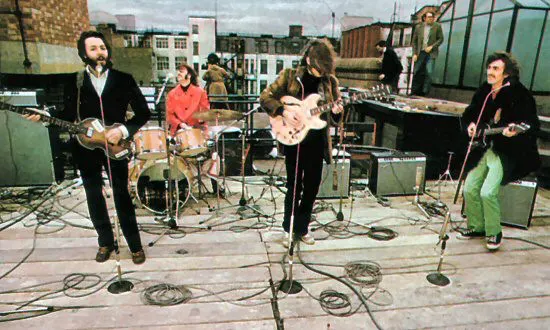
Take a good look. This is the last time they will ever perform live together. Image: Apple Films.
Lindsay-Hogg’s documentary film Let It Be captured people along the street during the show, some delighted, others merely bemused. They couldn’t actually see the band up on the roof, but the whole neighborhood heard the music pouring down from above. The police showed up and shut down the show, but by the time the bobbies got there, the Beatles had proven their point — they could still rock. John, Paul, George, and Ringo were still creative forces to be reckoned with, and they would still put out great music. They just wouldn’t be doing it together.
That rooftop show on January 30 would be the last time the Beatles would ever perform together in public. They continued tinkering with Let It Be on and off for another year. It was released in May 1970. By that point, the Beatles were all done. Each member had released or was about to release a solo record, and just a few weeks prior, McCartney called it quits and called for the band to dissolve. It was the first decision all four had agreed on in months.
But as is common in life, one door closes and another opens. On January 12, while John, Paul, George, and Ringo were bickering and quietly laying the groundwork for their post-Beatles careers, a new British band had dropped a new album. It was as if they had dropped a bomb.
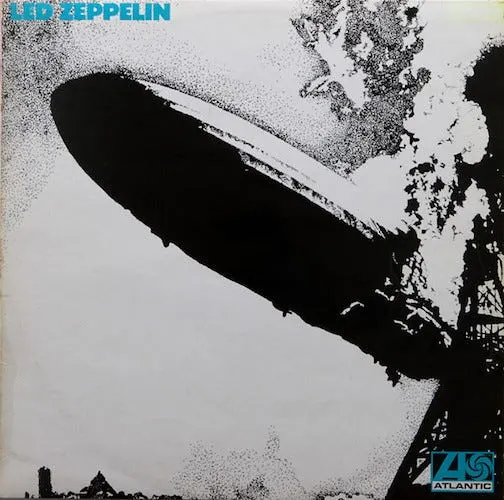
The original UK cover of Led Zeppelin I. The turquoise color of the lettering and logo only appeared on the first pressing. Image: Atlantic Records.
Led Zeppelin, the self-titled debut of a hard-hitting foursome from England, got good word of mouth in the UK and in the States, where the band was just beginning its first North American tour. Led Zeppelin seemed to come out of nowhere, but its members were no strangers to rock music.
Guitarist Jimmy Page came from the Yardbirds, a band that would become famous for also being the launching pad for fellow guitar gods Eric Clapton and Jeff Beck. The Yardbirds broke up in ’68, but there will still concert dates to fulfill, so Page was tasked with pulling together a lineup to make it happen. He approached a number of musicians, and through his connections and the recommendations of others, Page ended up with vocalist Robert Plant and drummer John Bonham, both from Band of Joy, and session musician John Paul Jones.
They performed as the New Yardbirds for the first time on stage in Denmark on September 7, 1968. There was no mistaking the chemistry. All four musicians were steeped in the blues and gritty backwater music of the American South. They were also into Celtic music, folk, jazz, and early rock and roll. And yes, Jimmy, Robert, John Paul, and John were all Elvis fans.
The four began composing and performing some great original work, and, upon returning to England, hit the studio to lay down tracks for a record. Page fronted the costs out of his own pocket, but the sessions were short and inexpensive as the songs were tight and ready to record after already having been played on the road.
They couldn’t perform as the New Yardbirds forever, though, and needed a new name. They came up with Led Zeppelin, after a comment made by Keith Moon and John Entwistle of the Who. Page had approached the two musicians in ’66 about forming a supergroup with himself, Jeff Beck, and Steve Winwood of the Spencer Davis Group. Moon and Entwistle told Page that the project would go over like a lead Zeppelin. In other words, it wouldn’t fly.
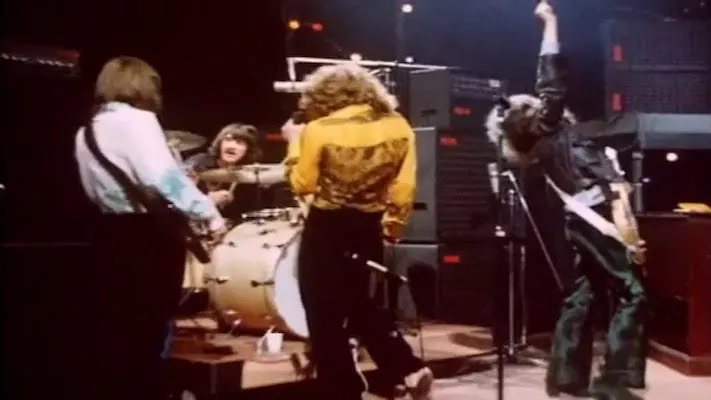
Led Zeppelin performs “Dazed and Confused.” One of the first of many epic live performances. Image: BBC.
Led Zeppelin played its first show with its ironic new name at the University of Surrey in England on October 25, 1968. By the start of the new year, they were touring the States, boosted by robust sales of their new album, which reached number 10 on Billboard and went gold in July 1969.
Zeppelin came on strong, played it loud, and held concert goers in a vice-like grip. They gave birth to a raw new sound filled with angst, sex, and power. It was called heavy metal, and it was the natural evolution of the music of Elvis Presley and the Beatles. And while Elvis and the Beatles made possible much of what had come before 1969 in rock music, Led Zeppelin would make possible pretty much everything that came after.