Kennedy Assassins on Trial

As February gave way to March in 1969, the American public was being forced to relive the twin tragedies that bookended the decade — the killings of John and Robert Kennedy. The trial of Sirhan Sirhan for the murder of Robert Kennedy was taking place in Los Angeles at the same time that businessman Clay Shaw was on trial in New Orleans for being part of a criminal conspiracy to murder John Kennedy.
The sad, shocking, and increasingly puzzling details of both assassinations were being bantered about nationwide like never before. On some days, the trials competed for space on newspaper front pages. Two headlines from the Sarasota Herald-Tribune on February 14, 1969 were, “Jury Given Sirhan’s Plan as State Presents Its Case” and “Shaw Trial’s Focus Switched to Dallas.” Sirhan was above the fold. That’s newspaper talk for being near the top of the page, and top of the news.
People were taking Sirhan’s trial very seriously. This angry, young Palestinian, a failed horse jockey, shot Sen. Robert Kennedy in cold blood. Caught at the scene of the crime. Wrestled to the ground firing his pistol, injuring five others. Above the melee, shouts of “Don’t kill him! Don’t kill him! No Jack Ruby.”
Robert Kennedy was only the second sitting U.S. Senator to be assassinated in American history. (The other was Huey Long in 1935.) More importantly, though, Robert Kennedy was hope personified. Like his brother John, Robert made a natural connection with the nation’s youth, and even more so with the poor and minorities. His meteoric rise during the 1968 primaries had many predicting another Kennedy-Nixon presidential contest, and the biggest Kennedy fans predicting a White House term that would cure all America’s ills. But a Robert Kennedy presidency was not preordained in 1968 as the modern mythology would have us believe. It was the promise of what could have been that was the victim here.
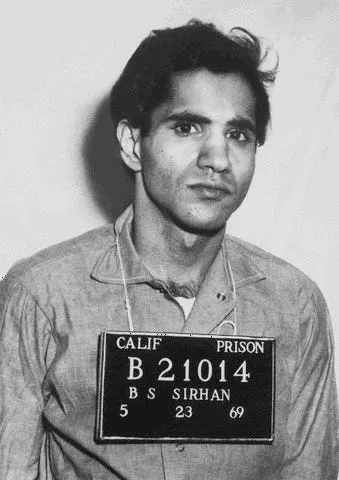
Much was made of Sirhan’s mental capacity at his trial.
Sirhan’s trial began on February 13, 1969, after weeks of pre-trial motions. Sirhan’s lawyers moved for a mistrial because of potential jury bias, then Sirhan wanted to change his plea from not guilty to guilty, presumably so that he could be executed. Judge Herbert Walker was hearing none of it, and the trial went forward.
Just a couple months later on April 17, Sirhan was found guilty of killing Robert Kennedy. He was sentenced to death, but that sentence was commuted to life (along with Charles Manson’s) when California outlawed the death penalty in 1972.
Long before Sirhan Sirhan had sworn vengeance on Robert Kennedy for his support of Israel (as goes the widely accepted excuse for RFK’s murder), an ambitious public servant was putting together a conspiracy case in the murder of JFK.
New Orleans District Attorney Jim Garrison arrested Clay Shaw on March 1, 1967, charging him as being part of a conspiracy with Lee Harvey Oswald and others to assassinate President Kennedy. It was a bold step for Garrison to make. Shaw was a longtime respected businessman in New Orleans, one of the founders of the International Trade Mart, a hub for promoting trade throughout Latin America and beyond.
Shaw, a World War II veteran, ran the Trade Mart from 1947 until his retirement in 1965. Garrison believed that Shaw was a contract agent with the Central Intelligence Agency the entire time, and that he provided material support to Lee Harvey Oswald in his plan to kill Kennedy. Garrison had witnesses who saw Shaw and Oswald together, of course one of them was a junkie who was getting high at the time.
Garrison took on a job that was beyond him. He had to prove there was a conspiracy to kill Kennedy (which would negate the whole Warren Report), AND that Clay Shaw was involved in said conspiracy, AND that Kennedy’s murder may have even been a coup directed from within our federal government.
The idea of a conspiracy intrigued the public. The Warren Commission report, released in 1964, did not settle the issue, and Americans wanted answers. With so much emphasis placed on John Kennedy when the decade began, his premature and violent death scarred the country. Everything froze on November 22, 1963. In the November 23rd World that followed, the question on many minds at many junctions was, “What if Kennedy had lived?” Would Vietnam have happened? Would America now be coming apart at the seams?
In the violent, chaotic world that people seemed to be confronted with every day in 1969, it seemed entirely plausible that JFK’s death was a conspiracy. It’s not possible for one lone, pathetic, communist sympathizer to bring everything to a screeching halt. He must have had help. Maybe even from the CIA, the ultimate extension of The Man’s power. Everything they did was crooked.
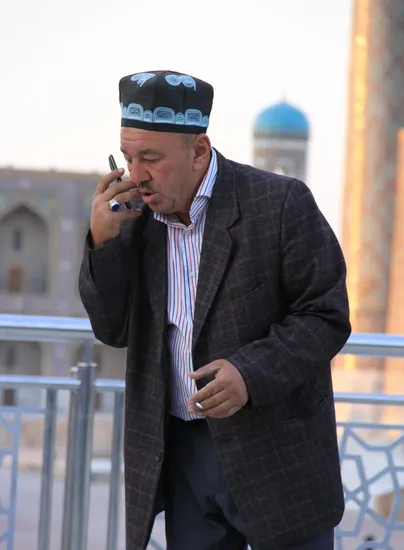
Shaw (right), here with journalist James Phelan, was a large man not easily mistaken in a crowd, a trait Garrison hoped to use to his advantage in court.
But whether that conspiracy included Clay Shaw was a bridge too far for a jury in New Orleans. On March 1, 1969, Shaw was acquitted and set about putting his life back together. He gave an interview to Penthouse magazine in September 1969 and denied he had any connection to the CIA. The trial bankrupted Shaw and his reputation never recovered. His lifetime smoking habit caught up with him, and Shaw died of cancer in 1974.
Garrison successfully fought off a corruption charge in 1973 he claimed was concocted by the federal government to drive him from office. Whether this was a paranoid fantasy or honest accusation, it worked. Garrison lost his bid for reelection as New Orleans DA to Harry Connick, Sr. (Yes, those Connicks.) Garrison later wrote On the Trail of the Assassins, a best-selling account of his case to crack the JFK conspiracy. It served as the basis for Oliver Stone’s controversial and well-crafted JFK in 1991. Garrison even has a cameo in the flick.
If Garrison did anything, it was to get people talking about the JFK assassination. No one had even heard of Abraham Zapruder before all this, his movie tucked away on a shelf before Garrison got his hands on it and shared it in a New Orleans courtroom. New federal rules passed in later years relaxed restrictions on secret documents. Through the Freedom of Information Act, we learned that Clay Shaw actually did talk to the CIA. During the 1940s and 1950s, Shaw would debrief CIA analysts about what he saw during his travels abroad. This was common practice during the Cold War, and Shaw was one of many American businessmen traveling internationally who were regularly interviewed by the CIA. It was not an exchange of government-toppling secrets; it was just a voluntary sharing of information gained through keen observation.
RFK’s assassination would eventually warrant its own conspiracy on account of ballistics and wound inconsistencies. Second shooters, girls in polka dot dresses, decoys. And Sirhan still has his supporters. One of the guys Sirhan shot doesn’t believe he did was responsible for Kennedy’s death. Robert Kennedy Jr. doesn’t seem to believe he did it, either. Last year, during the hype that surrounded the 50-year anniversary of Kennedy Sr.’s assassination, Kennedy Jr. has called for a new investigation into the event.
I wasn’t aware that the investigation had ever stopped. The official police investigation is dormant, but that doesn’t matter. There have been hundreds of books, hundreds of hours of TV documentaries, and dozens of films that explore the Kennedy assassinations. The answers are out there for those who need more.
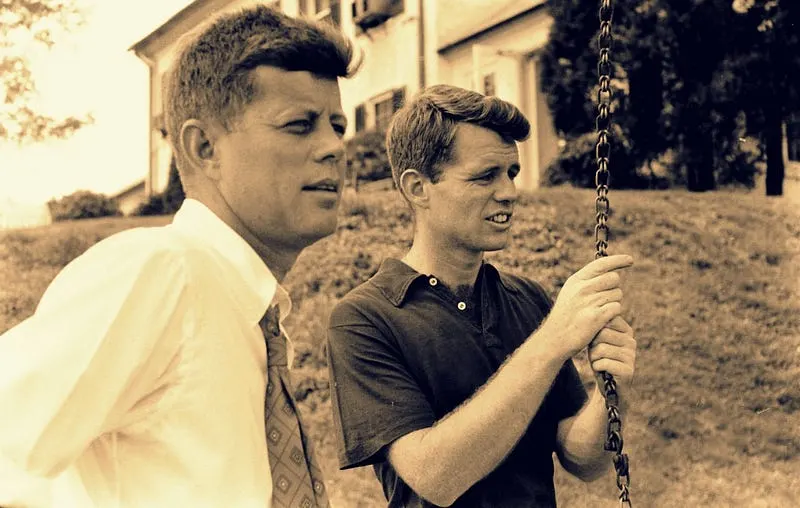
This is how the country dealt with the residual effects of back to back tragedies. John Kennedy’s ghost was still haunting the nation when his brother Robert was killed five years later. His death on June 6, 1968, just weeks after the murder of Martin Luther King, was an unrecoverable blow for many people.
The country was forced to relive the horror and pain of John Kennedy’s death all over again with the murder of Robert, his brother, his attorney general and closest political confidant, the heir apparent of Camelot. To lose one Kennedy seemed like an unfortunate, if random act of history. To lose them both seemed the malicious and deliberate act of a vengeful god.
Or one hell of a conspiracy.