When The Space Race Was a Dead Heat

On January 10, 1969, Apollo 8 astronauts Frank Borman, James Lovell, and William Anders were the most famous men in America. A ticker-tape parade was being held in their honor for being the first humans to orbit the moon.
Their mission in the final days of 1968 included maneuverability tests in lunar orbit, scouting possible landing sites for future missions, and snapping a photo of Earth from their capsule that was fast becoming an iconic image. America came one step closer to meeting President John Kennedy’s challenge to send men to the moon before the end of the decade. And with just a year to go before the 60s came to a close, that goal was within reach.
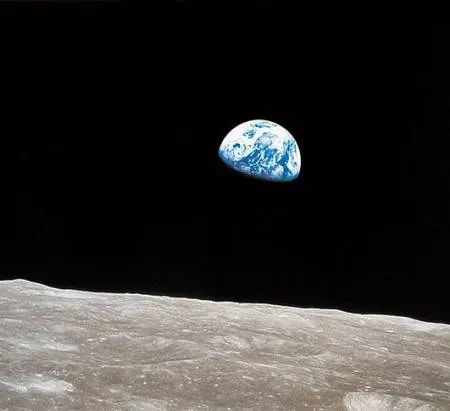
Earthrise, the photo that reminded us how fragile our world really is. Image: NASA.
But would America beat the Soviets?
It was hard to know the real status of the Soviet Union’s space program. They only ever broadcasted their successes, and the Kremlin, by its nature, was a teller of tall tales. It would take decades and the complete collapse of the communist superpower before we would ever know just how close the Russians were to sending men to the moon.
In January 1969, the Soviets were a formidable opponent in space. In fact, on the same day that the Apollo 8 astronauts were being showered with cheers and scrap paper in New York City, the Soviets launched Venera 6 toward Venus. It was the second Venus-bound Soviet probe launched in the last five days.
Venera (Russian for Venus) was the Soviet program to explore Earth’s closest planetary neighbor. Being an average of only 28 million miles away, Venus was the most likely first choice to send unmanned probes.
Astronomers have often called Venus Earth’s sister planet. The two planets are similar in size, mass, and relative distance from the sun. And if it weren’t for the fact that Venus has a surface temperature of 863 degrees˚F and an atmosphere that is almost pure carbon dioxide and rains sulfuric acid, you wouldn’t be able to tell the two planets apart.
The Soviet Venera program began in 1961, but Venera 1 and Venera 2 malfunctioned before reaching their intended target. Several probes were launched as part of the Venera program, but only those that were successful were given official designations. Anything that blew up on the launch pad, tumbled off into space, or otherwise crapped out became a nameless orphan.
Venera 3 gave the Soviets another impressive first in space exploration when it became the first human-made craft to touch another planet on March 1, 1966. Touch is a euphemism, really. Venera 3 crashed, pure and simple, leaving behind nothing but an unrecognizable hunk of twisted metal that by the time you read this has long since corroded into nothing on Venus’s unforgiving surface. Unfortunately, Venera 3 did little more than crash. Its sensors went dead before it penetrated the atmosphere. But it did leave behind a medallion with the Soviet state seal.
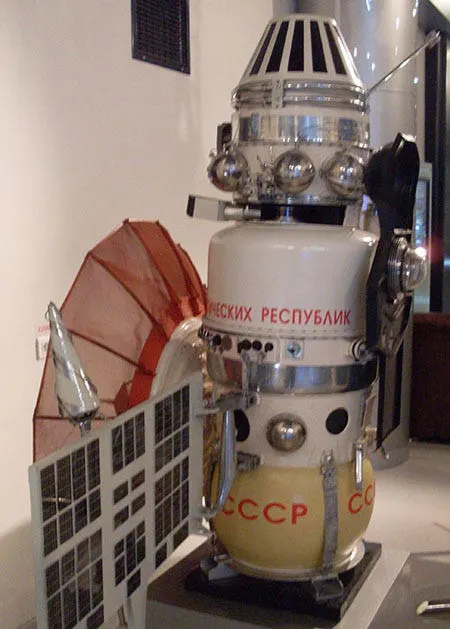
A mockup of the Venera 4 at Memorial Museum of Astronautics in Moscow. Image: Armael.
Venera 4 did better in 1967 by becoming the first spacecraft to measure Venus’s atmosphere. Technically, it was the first time a spacecraft measured any planet’s atmosphere beyond Earth. Even though the Soviets had racked up yet another first in space (You can see how this got discouraging for the Americans), Venera 4 didn’t do as well as the Soviets initially claimed.
The Soviets announced that Venera 4 had reached the surface of Venus intact. But America’s Venus-bound Mariner 5, which had launched on June 14, 1967, two days after Venera 4, told a different story.
America’s Mariner series was Russia’s closest competitor in the unmanned exploration of other planets. Launch for launch, America’s probes were more successful, but the Soviet Union was usually the first to reach its goals, with one glaring early exception. Mariner 2 had become the first human-made probe to do a flyby of another planet when it zipped past Venus in 1962.
Mariner 5 did a flyby of Venus on October 18, 1967, one day after Venera 4 supposedly landed on the planet’s surface. Mariner’s measurements determined that Venus’s atmospheric density was much greater than the Russians had figured.
The Russians mistakenly assumed that the air pressure at Venus’s surface was equal to 25 atmospheres (25 times the density of Earth’s atmosphere at sea level), so they built Venera 4 to withstand that level of pressure. Anything greater than that and the probe would be crushed like a soup can run over by a dump truck.
When Venera 4 stopped transmitting data, the Russians assumed that it had reached the surface and succumbed to the planet’s atmospheric pressure. In reality, 25 atmospheres was the pressure at 16 miles above the surface, which was how far Venera 4 got before it crumpled and stopped transmitting. Venus’s actual surface pressure is closer to 90 atmospheres.
The Soviets learned from this mistake and from the embarrassment of having to retract their landing announcement thanks to the pesky Mariner 5. Venera 5 and 6 were constructed to be slow-descent atmospheric probes, but in January 1969, their rendezvous with Venus was still four months away.
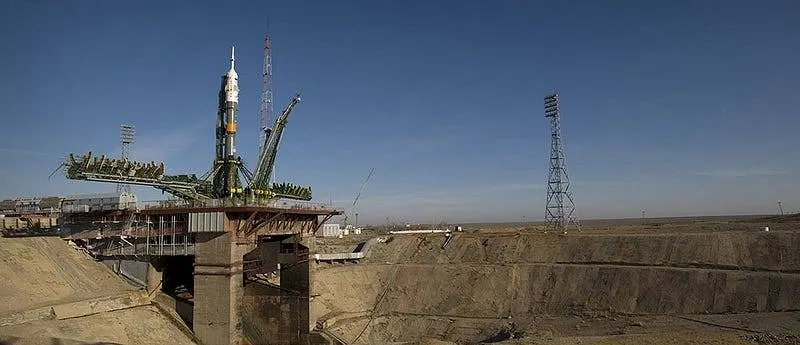
The Soyuz launch pad at the legendary Baikonur Cosmodrome, home to many of Russia’s greatest space achievements. Image: NASA/Bill Ingalls.
Mother Russia was not done showing off, though. On January 14 and 15, 1969, back to back launches sent Soyuz 4 and Soyuz 5 into space. On January 16, the two craft docked in orbit, and two cosmonauts moved via spacewalk from Soyuz 5 to Soyuz 4. The design of the Soyuz craft at the time prevented internal movement between docked capsules, forcing the cosmonauts to go outside one craft into space and back into the second craft via airlock.
The exercise was a prelude of how the Soviets intended to execute their lunar mission, with one cosmonaut spacewalking from the orbital capsule to the lunar lander and traveling down to the moon’s surface.
Soyuz 4 and 5 returned to Earth with their transferred crews on January 17 and 18, respectively. The Soviet’s orbital crew transfer and spacewalk were, yep, you guessed it, the first ever human transfer in space. Like Apollo 8’s lunar orbiting mission, Russia’s Soyuz 4 and 5 docking exercise was a big step toward landing on the moon. But who would get there first?
1969 was going to be a long year in the Space Race.


