Congress, the President, and the Power to Make War

In August 1964, Congress voted overwhelmingly to give President Lyndon Johnson unprecedented power to commit American troops to Vietnam. I took a look at the political maneuvering behind the resolution, and then it got me thinking about similarities and disparities to the Iraq War. And then all the other conflicts, large and small, that the U.S. has been involved in over the last 70 years.
War is serious business, and it is not to be taken lightly. But for all the talk we hear from politicians about wanting to avoid war, we seem to find ourselves tangled up in a lot of conflicts. This has to do in large part with America’s station in the world. Some see that as protector of freedom. Others see it as imperial adventurism.
I’m not going to weigh in on that argument except to say that both points of view have their merits. I am more curious about how the most awesome of federal powers — the power to declare war — has shifted over time.
According to the U.S. Constitution, Congress has the power to declare war. Some say that the Founders used pretty vague language in the Constitution, but on the subject of war-making powers, they were crystal clear.
Sort of.
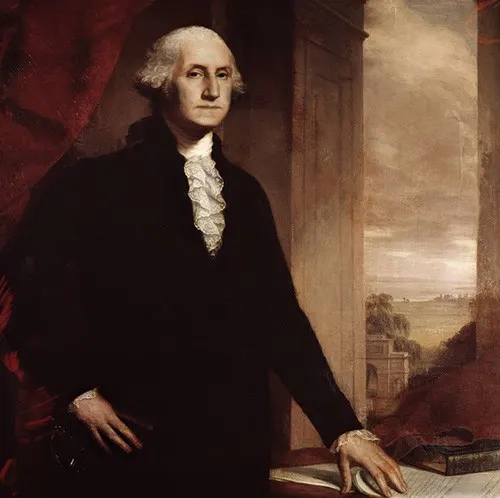
George Washington believed in the old adage, “If you want peace, then you prepare for war.” But he might think we’ve gotten a little carried away.
Article I, Section 8, Clause 11 of the U.S. Constitution states that Congress alone has the power to declare war. Other clauses in the same section grant Congress the power to raise armies and a navy, and provide for the organization, training, and supporting the same.
It gets a little sticky after that, though. Congress can declare war and raise an army, but the president is the commander-in-chief of the armed forces. Article II, Section 2 of the Constitution states that the president “shall be commander in chief of the Army and Navy of the United States, and of the militia of the several states, when called into the actual service of the United States.”
The Founders wanted a nation built on commerce, not conflict. The process of declaring war was not meant to be simple, requiring the country to pick and choose its battles wisely. To this end, the Constitution requires that Congress and the Executive branch, namely the president, work in concert to declare, fight, and win a war.
Congress has officially voted to declare war 11 times in American history, the last being during World War II. Each time the vote has been unanimous or near-unanimous. The whole war-making enterprise ran pretty smooth from America’s founding right up through 1945. In each instance, the president went before Congress and laid out his case. Congress agreed that a declaration was warranted, and off to war we went.
Things got complicated during the Cold War. America was responsible for more than just what lay between her shores. Our superpower role put us in the position of protecting freedom from the communist threat — pervasive, far-reaching, rapid, unpredictable. With the Soviet Union propping up revolutions, coups, and invasions in places all over the globe, the U.S. had to be able to stand ready to meet force with force wherever the need arose. The most zealous anti-communists in the government and the military believed we had to oppose the Soviets on every front. That’s a lot of war declarations.
Technology made matters even more complex. The introduction of ICBMs and SLBMs (submarine-launched ballistic missiles) meant that a devastating war could begin and end within an hour. By the time the president found out that we were under attack and thought about asking Congress for a declaration of war, Capitol Hill would be a pile of radioactive rubble. Our nation’s survival demanded that the president have more flexibility to protect the country and our allies from the spread of communism.
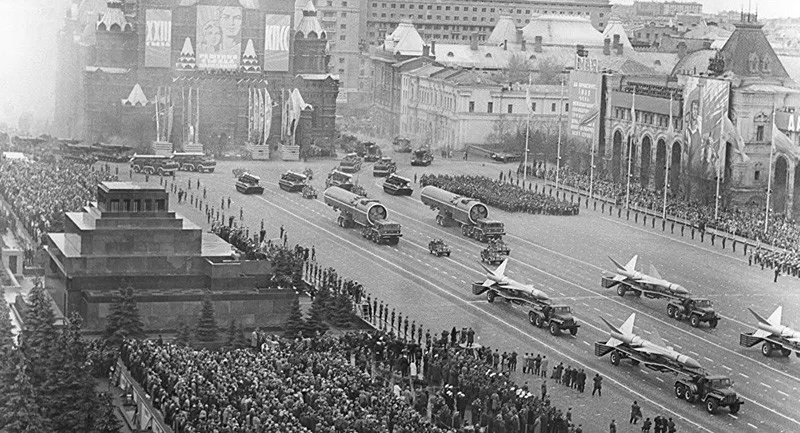
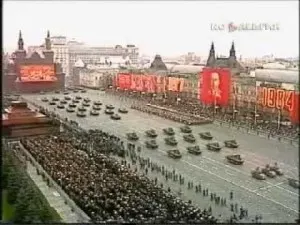
Scenes like this in Moscow proved to America that the Soviet Union was no idle threat. Image: Sputnik / Yuryi Abramochkin.
Or so the argument went.
Right or wrong, the stated need to combat the spread of communism and protect America from nuclear attack slowly but surely chipped away at Congress’s war-making powers granted to it by the Constitution. At the same time, each succeeding president’s power to make and carry out war grew, encouraged by the circumstances of the moment, the Pentagon, and their own national security teams.
Just about every president since World War II had their part to play. Harry Truman committed American troops to protect South Korea in 1950. The Korean War was a war by pretty much any practical measure. Over 325,000 American soldiers were deployed, and 35,000 were killed in three years of brutal combat. We went toe to toe with Communist China, and there was talk of going nuclear. But technically, Korea was a United Nations “police action” that did not require a formal war declaration by Congress.
The Vietnam War was not a formally declared war, either. Twice as many troops involved, almost twice as many deaths, and three times as long as Korea. Presidents Dwight Eisenhower and John Kennedy were sending American troops to Vietnam (and a few other hotspots as well) before anyone could even point it out on a map.
Then came the Gulf of Tonkin Resolution I mentioned earlier, which on August 7, 1964 gave President Lyndon Johnson power “to promote the maintenance of international peace and security in southeast Asia.” How much broader can you get in terms of defining a president’s power? And how do you reel that power back in?
The Gulf of Tonkin Resolution was inspired by an attack that many now say didn’t even take place. Even at the time, many who were “in the know” questioned the validity of the attack on U.S. warships in the Gulf, but every member of the House and all but two Senators voted to give Johnson a blank check to stop communism before it swallowed up all of Southeast Asia.
Johnson, with little foreign policy experience and zero military experience, insisted on living out his commander-in-chief responsiblities to the full. He weighed in heavily on bombing targets and military campaigns, and tried to run the whole war from the White House basement. We all know how that turned out.
The Vietnam War was a reality check for Congress. Realizing that they had surrendered their Constitutional war-making authority, they tried to regain what was lost with the War Powers Resolution of 1973.
The resolution stated that the president’s powers as commander-in-chief are exercised only due to a declaration of war, specific authorization from Congress, or a national emergency created by an attack upon the United States. The president would also be required to consult with Congress before introducing troops in harm’s way, and they must be withdrawn after 60 days unless the president submits a report to Congress detailing the reasons for their continued deployment. Congress then has the power to accept the report or demand a recall of forces.
The resolution was passed over President Richard Nixon’s veto, and all presidents since have complained about being hamstrung by its provisions. After all, power once given is very, very, very hard to take away. The argument that the War Powers Resolution infringes on the president’s Constitutional duties seems odd considering that those duties were originally assigned to Congress by the Constitution.
The ability of the War Powers Resolution to rein in the president’s unilateral military actions has been spotty at best. President Ronald Reagan worked with Congress when he sent the Marines to Lebanon in 1982, but he did not consult Congress when he sent military advisors into El Salvador in 1981, troops into Grenada in 1983, or when he attacked Libya in 1986.
President George H.W. Bush did not believe he needed Congressional approval to oust Iraq from Kuwait in 1990 because he was acting to carry out United Nations resolutions. He did, however, receive Congressional support for Operation Desert Storm.
President Bill Clinton also used the reasoning that he was acting on U.N. resolutions when he ran afoul of Congress during the extended deployment of U.S. forces in the former Yugoslavia in the 1990s. Members of Congress tried to enact legislation to end the campaign, and, when that didn’t work, sued Clinton in court. The court ultimately ruled in Clinton’s favor.
Shortly after the terrorist attacks of September 11, 2001, Congress passed a law giving President George W. Bush authority to “use all necessary and appropriate force against those nations, organizations, or persons he determines planned, authorized, committed, or aided the terrorist attacks that occurred on September 11, 2001, or harbored such organizations or persons, in order to prevent any future acts of international terrorism against the United States by such nations, organizations or persons.”
While this wording seemed to link military action directly to the 9/11 attacks, it created an open-ended opportunity for the president to commit military forces against terrorists anytime, anywhere. It was almost as if the terrorist threat replaced the communist threat, giving the executive branch a reason to continue deploying American military assets around the globe and filling in Congress after the fact.
Bush vigorously exercised the authority given him, going after Al Qaeda in Afghanistan and elsewhere, then going after Saddam Hussein in Iraq.
Using the war against terrorism as a pretext for invading Iraq was a tough sell. On the one side, you had Saddam Hussein — guilty of using weapons of mass destruction, committing genocide against his own people, violating just about every U.N. sanction placed on him, and being a general menace to civilization. On the other side, there was skepticism about whether Saddam was still producing weapons of mass destruction, and few people could see any connection between him and 9/11.
The reasons for toppling Saddam Hussein had all been used before and since in other instances of unilateral presidential deployment of military forces. But Iraq would require a major investment of American power, a lengthy stay in-country, and the support of Congress, which Bush received.
There was no formal declaration of war, but both chambers of Congress passed the Authorization for the Use of Military Force Against Iraq in October 2002. There was solid bipartisan support for the measure, although many Democrats would publicly regret or explain away their yea votes in the years to come, including future presidential candidates John Kerry and Hillary Clinton.
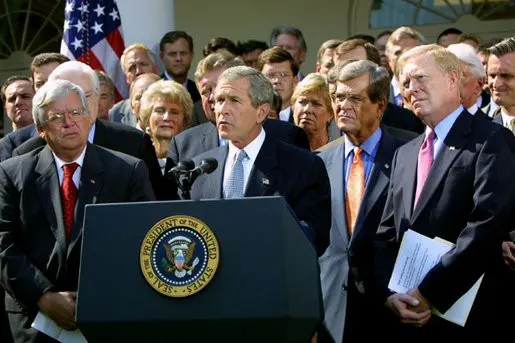
George W. Bush got a lot of support for the Iraq War. At first. Image: White House photo by Paul Morse.
The start of the Iraq War came before Barack Obama was elected to the U.S. Senate, but as a candidate to succeed Bush in 2008, Obama argued against the wide-ranging military powers Bush wielded. As president, though, Obama was quite comfortable significantly ramping up drone strikes and committing U.S. forces in Libya and interceding in the Syrian civil war. Again, without declaring war or following the protocol of the War Powers Resolution.
Is the presidency to blame for usurping war-making powers? Definitely maybe. The president is charged with the Constitutional duty to preserve, protect, and defend the country against all enemies, and he has been granted the command of the military to do so. Each candidate for that high office claims they want to roll back military engagements, but once they walk into a room and the band starts playing “Hail to the Chief,” their outlook changes. The true nature of the world’s dangers becomes frighteningly clear. And the allure of having America’s massive military power at their fingertips sometimes proves too tempting to tame.
Members of Congress certainly shoulder some of the blame for the expansion of the president’s war-making powers. They enact laws like the Gulf of Tonkin Resolution and the Iraq War Resolution, giving the president broad military powers, and then scratch their heads when things go awry. They have a strong sense of politics, but not of history or human nature. They tried to fix the situation with the War Powers Resolution, but have rarely held the president accountable when he deviated from it. Plus, the resolution itself is not a perfect piece of work, and it seems to raise a new Constitutional question for each one it answers.
The Constitution made going to war difficult for a reason. Today, politicians have used the complexities of the modern world as an excuse to make it easier. I can’t say whether this has made us safer or put us in more danger, or whether we would have fewer or more enemies otherwise. But I do know that America was not meant to be in a state of perpetual conflict. And we should be more careful about sending our men and women into harm’s way.