Is ‘Heaven’s Gate’ Really a Bad Movie?
I don’t do much channel surfing these days. There’s not a lot of quality programming to be found, and I’m pretty content with what streams on Netflix, Hulu, and Amazon. Just the same, I found myself in front of the tube one late weekend night recently, and I saw listed. The full, honking 3 hour, 39-minute feature splayed out on the TV guide, blocking out the whole evening’s listing like a World Series game.
I had never seen the whole movie. Tried it once on VHS years ago and passed out before I got through the first cassette. But I’d sure heard about it.
Heaven’s Gate: the movie that sank United Artists, that torpedoed director Michael Cimino’s career, that ended the era of the auteur director, that critics called “an unqualified disaster” and was like being taken on “a forced four-hour walking tour of one’s own living room,” that was cruel to animals, that was the biggest box office bomb in history. Et cetera and so forth.
The movie that was supposed to be Michael Cimino’s magnum opus, even more magnum opus-y than his previous film The Deer Hunter, became synonymous with failure. Heaven’s Gate was to film what Edsel was to automobiles, what New Coke was to marketing, what the Spruce Goose was to aviation…you get the idea.
Heaven’s Gate was Cimino’s follow-up to the 1978 Vietnam War classic which won the Best Picture Oscar and secured him an Oscar for Best Director. It was an era when the rough and tumble young turks of “New Hollywood” like William Friedkin, Martin Scorsese, Francis Coppola, George Lucas, Steven Spielberg, et al had smashed the Hollywood studio system, making truly great cinema on their own terms. And Cimino was the Golden Child. He could have told producers that he wanted to make the first 20 pages of the phone book as his next project, and they would have written him a check.
As it turned out, Cimino wanted to make a film based on the Johnson County War, a brutal conflict between homesteaders and cattle barons that took place in Wyoming between 1889 and 1893. Cimino had more in mind that just a western. He wanted to make an epic about love and loss, friendships torn asunder, greed, prejudice, the haves and the have-nots, immigrants and settlers, the promise and failure of the American Dream, all played out against the beautiful panorama of western vistas where Heaven and Earth meet — Heaven’s Gate. (I’m not entirely sure that is what inspired the title, but it sounds about right, so I’m going with it.)
United Artists gave Cimino a big, overflowing bucket of money to make his film, and away he went to make the movie of the ages. At least that’s what everyone figured was going to happen.
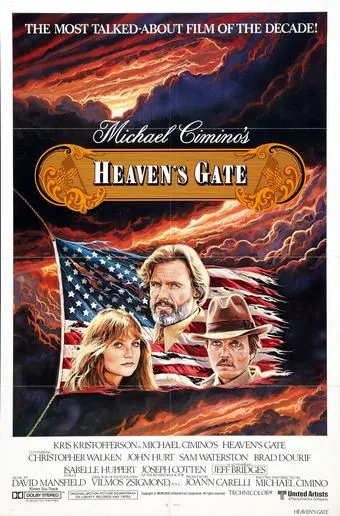
“The most talked-about film of the decade!” It sure was.
Stories spread quickly about a film set that was out of control. Dozens of takes for even simple shots, entire sets torn down and rebuilt three feet to the left (I’m not kidding), shooting days spent sitting around waiting for the right clouds in the sky, animals harmed or killed during stunts. The budget ballooned rapidly due to Cimino’s constant reshoots and hyper-keen eye for detail, striving for authenticity with items that weren’t even going to be seen on camera.
It was said that by six days into production, Heaven’s Gate was already five days behind schedule. The shoot lasted almost a full year, and by the time United Artists grew the testicular fortitude needed to fire Cimino, they realized they couldn’t because they were in too deep with him already. To replace the irascible director at such a late date would mean the entire $44 million investment ($132 million in today’s dollars) would be a loss.
Cimino’s final cut weighed in at 219 minutes and premiered to audiences at the end of 1980. The results were horrible. Audiences found it long and muddled. Critics savaged it. The trouble was that so much bad press had preceded the film’s release, there was no way to tell where the backlash over the production ended and an honest assessment of the film itself began.
Cimino’s on-set behavior and outsized ego burned a lot of bridges with the Hollywood crowd, and there is little doubt that some of them used Heaven’s Gate to take him down a peg or two. The studio forced him to drastically recut the film, and he came back with a 149-minute version that fared even worse with audiences. All told, Heaven’s Gate ended up with a box office take around $3.5 million.
Well, that’s great and all, but is Heaven’s Gate any good? Reviews and press from the time criticize the film’s pacing, storyline, and acting, but inevitably get into the weeds about the production, and Cimino’s behavior, and wild horses, and the overblown budget. Who cares? What about the movie, man?
Truth be told, any film that runs 20 minutes shy of four hours is going to require some intellectual endurance on the part of the viewer. At some points, the movie gets bogged down by the weight of its own effort, almost like Cimino is whispering in our ear, “Look at this, and this over here. And isn’t this cool?”
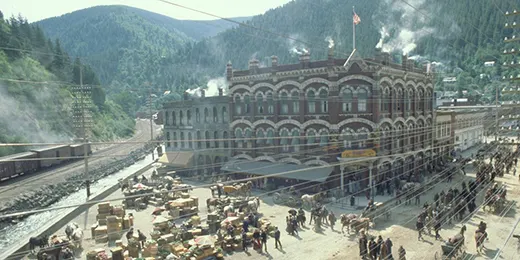
The look of the film is amazing. Heaven’s Gate has some stunning cinematography, and the larger set pieces like the introduction to the Wyoming cattle town, the (yes, you read that right), and the final showdown between the cattlemen and the homesteaders are masterpieces of filmmaking. The attention to historic detail is also to be commended. There are points when you feel completely transported into the time period.
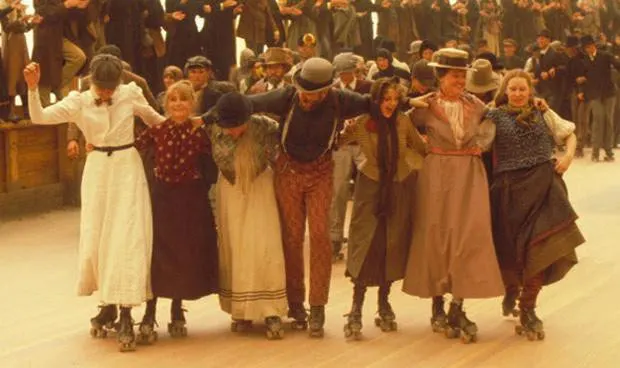
Told you there was roller skating. Image: United Artists.
The story, however, is not thick enough to warrant a three-and-a-half-hour movie and is better suited to a much shorter film. The main focus is supposed to be a conflict between Kris Kristofferson’s Jim Averill and Christopher Walken’s Nate Champion over the affections of Ella Watson, played by Isabelle Huppert. Averill is an idealistic lawman, Champion a hired gun for the cattle barons, and Watson the madame of a local brothel.
This storyline has a few problems. Compared to the length of the film, little time is spent exploring it or fleshing it out. We don’t get the urgency of it. We don’t quite understand why Huppert is conflicted over the two men or how she came to fall in love with both of them. There’s also the issue of Huppert as an actress being overshadowed by Walken and Kristofferson. These two actors turn in fine performances as you’d expect they would, but at the time Huppert was an ingénue, with little acting experience and not a lot of charisma. UA executive Stephen Bach said to the director at the time, “For Christ’s sake, Michael. Kristofferson and Walken are so much more attractive than she is that the audience will spend the entire film wondering why they’re [having sex with] her instead of each other!”
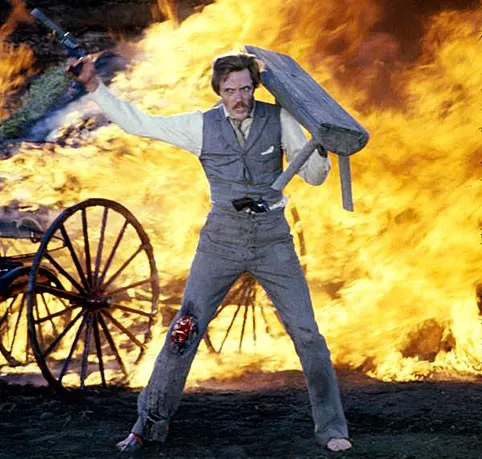
Christopher Walken prepares to meet his maker. Image: United Artists.
That particular thought hadn’t crossed my mind, but I do believe Huppert was miscast, and it does pose a problem for the film that is tough to get around.
The opening sequence is a sort of prologue with Kristofferson and his school chum, played by John Hurt (who randomly pops in and out throughout the film), graduating from Harvard. It goes on for a good 20 minutes or so and leaves you wondering what the film is all about. Joseph Cotten, in one of his last screen roles, gives a rambling monologue about education, class, duty, and all that jazz. It’s meant to be a tease of the themes that will play out later in the film, but the message gets lost because the sequence is too long and we’re not quite sure what we’re doing in Harvard in 1870 when we clearly sat down to watch a movie about Wyoming in 1892.
When the narrative is on target, it moves along crisply and keeps you locked in. The escalating tensions between the cattle barons and the homesteaders plays out in a few key scenes, and you get the sense that something big and devastating is looming in their future. And for all its faults, the love triangle between Kristofferson, Walken, and Huppert does get a payoff when the two men finally square off later in the film.
With the exception of Huppert, the cast is filled with talent. Jeff Bridges, along with Brad Dourif and Richard Masur, and a young Mickey Rourke turns in one of his first roles. Even Willem Dafoe shows up. It was his very first role in a movie, and if you blink you might miss him. And Sam Waterston, as the evil leader of the cattle barons, would be twirling his mustache if it were long enough.
In sum, Heaven’s Gate is a mixed bag. It hardly deserves the title of “worst movie ever,” but it’s certainly not the American cinematic masterpiece as they’re hailing it in Europe these days. It is too long, but I would not suggest watching the 149-minute cut in place of the full version as that is so chopped up, the narrative gets completely lost.
Heaven’s Gate has some good qualities that make it worth watching. I would suggest that any film school student or any film buff who wants a lesson in what to do and what not to do with a movie should see it. If you’ve heard of the film and are curious about it, give it a look-see. It won’t change your life, but it’s a rainy afternoon guilty pleasure that you just might like. But if you’re looking for a rock ’em, sock ’em western or a riveting and glorious film epic, you won’t find it here.